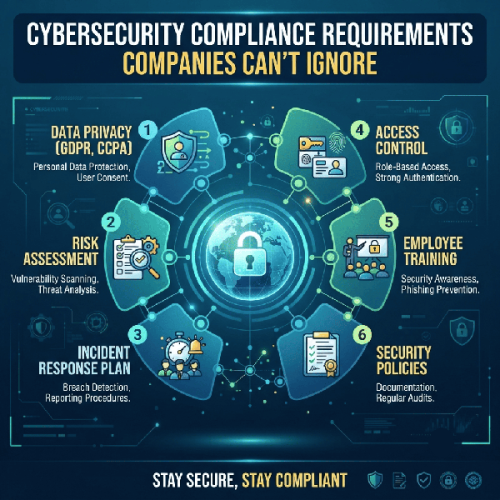
In 2026, cybersecurity compliance has shifted from "periodic, static checklists" to continuous, real-time resilience. Organizations are increasingly held to higher standards of operational discipline, particularly concerning AI governance and third-party risk.
Below are the critical cybersecurity compliance requirements and trends that companies cannot ignore.
1. AI Governance & Security
As AI adoption accelerates, regulators are focusing on the integrity and security of AI systems. You must be able to prove that your AI models are transparent, auditable, and secure.
-
Risk Assessment: You must conduct and document formal risk assessments for all AI use cases, focusing on data poisoning, prompt injection, and model output accuracy.
-
AI Supply Chain: Companies are now required to govern third-party AI model dependencies and ensure data privacy is maintained throughout the model lifecycle.
-
Human-in-the-Loop: Regulators increasingly require human oversight to validate AI-driven decisions, particularly in financial or safety-critical processes.
2. Continuous Compliance vs. Periodic Audits
The era of "annual" compliance audits is effectively over.
-
Continuous Assurance: Leading organizations are deploying automated tools to continuously validate security controls. If a control fails, it must be detected and remediated immediately rather than waiting for the next audit cycle.
-
Real-time Visibility: You must maintain a centralized, real-time dashboard that maps controls to specific regulations (e.g., GDPR, HIPAA, DORA, ISO 27001) to demonstrate compliance at any moment.
3. Identity as the New Perimeter (Zero Trust)
With the dissolution of the traditional network perimeter, identity has become the primary control point.
-
Zero Trust Enforcement: Compliance mandates now frequently require proof of "least-privilege" access. You must verify every access request, regardless of origin, using multi-factor authentication (MFA) and behavioral analytics.
-
Credential Management: Continuous authentication—monitoring user behavior for anomalies during a session—is becoming a standard requirement for sensitive operations.
4. Supply Chain & Third-Party Risk Management
Third-party "spillover" (breaches originating from a vendor) is a major regulatory concern.
-
Vendor Due Diligence: You are responsible for the security of the vendors you integrate with. This includes automated risk scoring and formal contract structures that mandate the vendor’s adherence to your security standards.
-
Operational Resilience: Regulations like the Digital Operational Resilience Act (DORA) mandate that you not only protect systems but also prove that your business can remain operational during a cyber incident.
5. Personal Liability for Executives
A significant trend in 2026 is the shift toward executive liability.
-
In many jurisdictions, board members and C-suite executives are facing increased scrutiny and potential personal legal repercussions if they fail to implement adequate cybersecurity governance. Cybersecurity is no longer just an "IT problem"; it is a core fiduciary duty.

krishna
Krishna is an experienced B2B blogger specializing in creating insightful and engaging content for businesses. With a keen understanding of industry trends and a talent for translating complex concepts into relatable narratives, Krishna helps companies build their brand, connect with their audience, and drive growth through compelling storytelling and strategic communication.